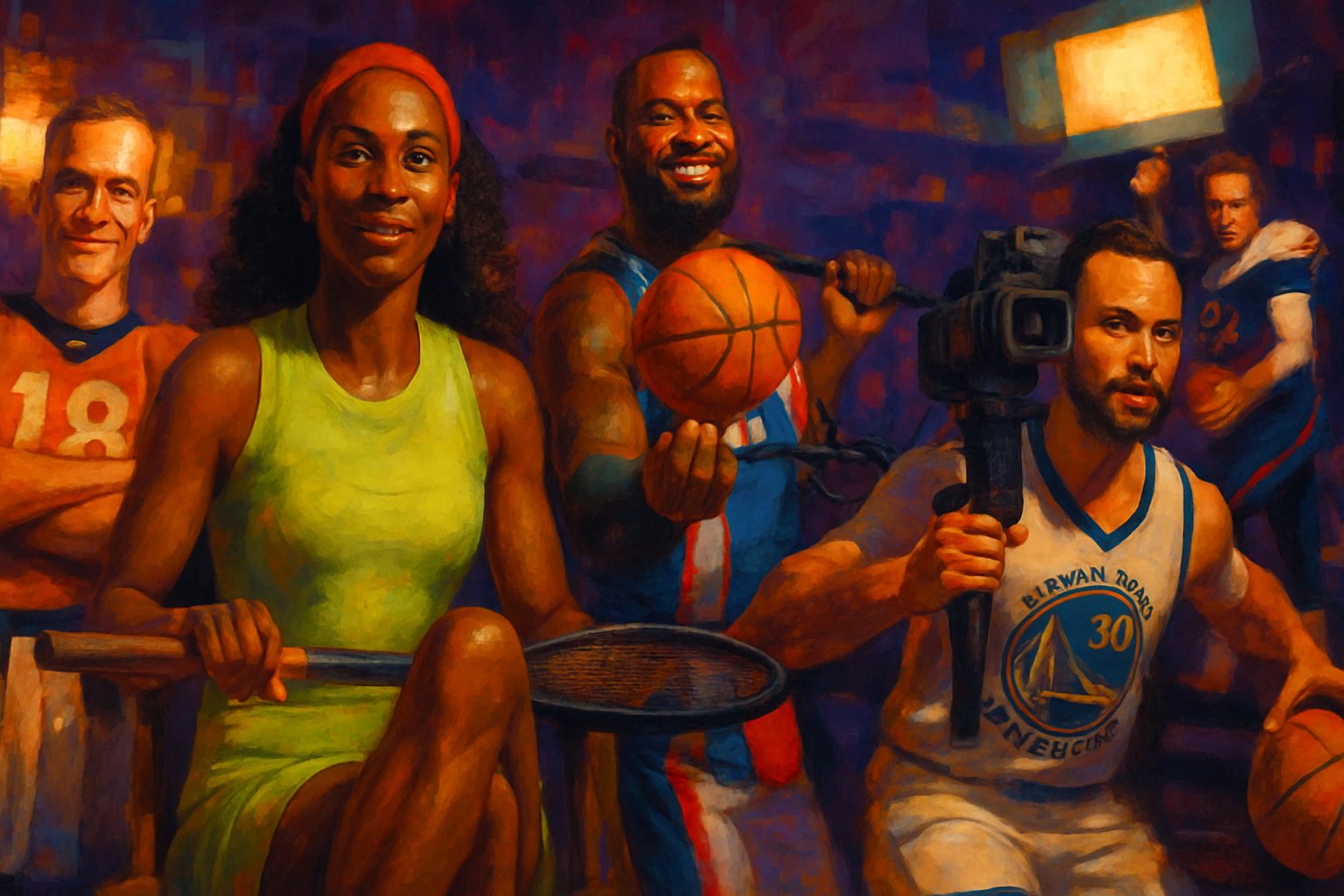
The history of athletes and Hollywood is long, occasionally distinguished, and more often than not, brief. But the current generation of sports stars has concluded that if someone is going to profit from telling their stories, it might as well be them.
Coco Gauff, the 22-year-old tennis champion who is currently the world's highest-paid female athlete at $31 million annually, has joined the procession. Earlier this year she formed iROC Media Group and promptly entered a joint venture with Religion of Sports, the production company founded by Tom Brady, Michael Strahan and Gotham Chopra. The partnership has already yielded its first projects: two short documentaries for the Tennis Channel, one about fashion in tennis and another about Zina Garrison, the first Black woman to reach a Grand Slam singles final in the Open era.
Ms. Gauff, who is represented by WME, admits to some nervousness about adding "executive producer" to a résumé that already includes two Grand Slam titles and the distinction of being the youngest player to qualify for the Wimbledon main draw. "I didn't know how people would perceive it, to be honest," she said.
She is hardly alone in her ambitions. A 2025 study by USC Annenberg's Norman Lear Center identified 33 athlete-owned production companies that have generated more than 370 media properties. LeBron James, Stephen Curry, Peyton Manning, Kevin Durant, Naomi Osaka and Tony Hawk have all established similar ventures. Last week, Buffalo Bills quarterback Josh Allen announced his own entry, Out of Pocket Studios, in partnership with Skydance Sports.
The rationale is consistent across the locker room. "I got sick and tired of the media changing the narrative," Mr. James said in 2022, explaining his decision to build what became the SpringHill Co.
(Athletes have historically been subjects rather than authors of their own stories. The new math suggests they would prefer to collect the royalties.)
The path has not been uniformly smooth. Bloomberg reported in 2024 that SpringHill had never turned a profit, having lost a combined $45 million over two years. Other celebrity-backed media ventures have undergone layoffs or missed projections. The post-pandemic contraction of Hollywood budgets has made the degree of difficulty considerably higher.
"Any athlete can walk a project in and have it sell, quote unquote," said Josh Pyatt, formerly of WME Sports and now a partner at the investment firm WTSL. "Getting it made, getting multiple projects made and creating real enterprise value is something that not many can actually do."
Ms. Gauff estimates she put about five to seven hours of work into the two short films — understandable, given her tennis schedule, which currently has her in the quarterfinals at the United States Open. The daily operations belong to her partners.
Her long-term ambitions, however, are clear. "Hopefully, by the time I retire," she said, "we build something that can sustain itself without me promoting it as an active player."
She is 22. There is time.
Original story published in The Hollywood Reporter: "The Athlete Is the Studio"